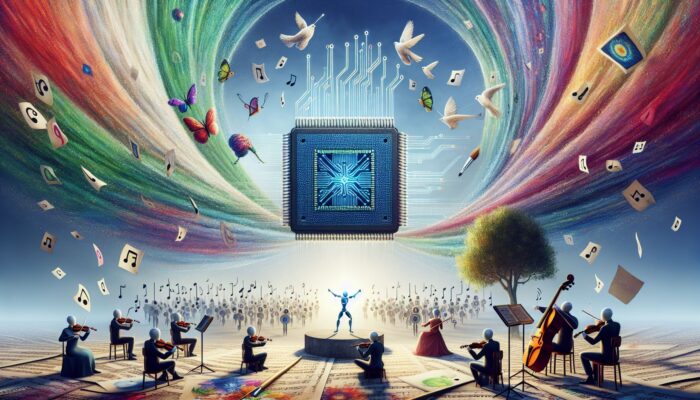
The Carnival of Certainty: Embracing AI’s Role in the Future of Creative Arts
Hey there, fellow digital explorers! I’m diving into something that’s been on my mind lately: how AI is shaking up the creative world. It’s wild to see what happens when algorithms start making art. Cold, calculating machines suddenly producing work that hits you right in the feels? Yeah, that’s worth talking about.
AI Crashes the Creative Party
Here’s what’s happening: AI isn’t just crunching spreadsheets anymore. These systems are composing music that gives me chills, writing stories that keep me up at night, and creating visual art that honestly makes me question what I thought I knew about creativity. You know that feeling when you see a painting that looks like Picasso had a wild night with a computer? Well, now that’s actually possible.
Look at DALL-E from OpenAI. The name’s a clever mashup of WALL-E and Salvador Dalí, which pretty much sums up what it does. You type in something ridiculous like “quokkas breakdancing on a moonlit pier” and boom, there’s your image. It’s like having a hyperactive art student who never sleeps and takes every weird request seriously.
But Wait, Who’s the Real Artist Here?
This brings up the big question that keeps me awake some nights: when a computer makes art, who gets the credit? The algorithm? The programmer? The person who typed the prompt? It’s messy territory, and honestly, I’m not sure we have good answers yet.
Human artists spend years developing their voice, their technique, their perspective on the world. They pour personal experience and emotion into every piece. An AI, on the other hand, is essentially a very sophisticated pattern-matching system that learned from millions of existing artworks. It’s impressive, sure, but is it really creating something new or just remixing what already exists in really clever ways?
The Ethics Get Complicated Fast
Then there’s the elephant in the room: most AI art systems trained on existing artwork without asking permission. Imagine spending years perfecting your style, only to find out a machine learned to mimic it by studying your work without your consent. That stings.
And let’s be real about the economic impact. If AI can pump out decent illustrations in seconds, what happens to freelance artists? Some will adapt and use these tools to enhance their work, but others might find themselves priced out of the market entirely. It’s not just theoretical anymore, it’s happening right now.
What’s Coming Next?
I think we’re heading toward a world where the most successful creatives will be those who figure out how to dance with AI rather than compete against it. Maybe that means using AI as a brainstorming partner, or as a way to quickly mock up ideas before diving into the real work.
The technology will keep getting better, that’s inevitable. But I suspect the human touch will become more valuable, not less. People crave authenticity, stories that come from real experience, art that connects on a human level. AI might be able to mimic the surface, but can it capture the messy, beautiful reality of being human?
My Take on All This
I’m fascinated and a little unsettled by where this is all heading. AI art tools are undeniably powerful, and some of the output is genuinely impressive. But there’s something irreplaceable about human creativity, about the way personal experience and emotion filter through an artist’s work.
Maybe the future isn’t about AI replacing human creativity, but about finding new ways for them to work together. The artists who thrive will probably be the ones who embrace these tools while staying true to their own unique perspective. Because at the end of the day, we’re not just looking for pretty pictures or catchy tunes. We’re looking for connection, for someone to help us make sense of this weird, wonderful world we’re all trying to navigate together.