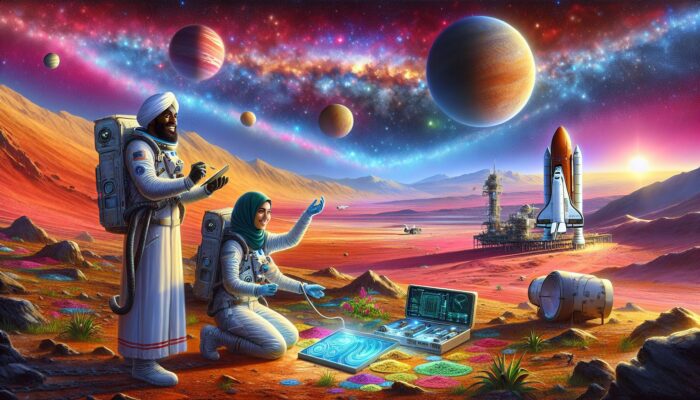
Unveiling the Future: Space Travel Beyond the Horizons
When it comes to technological frontiers, nothing grabs my attention quite like space travel. Sure, AR headsets and self-driving cars are cool and all, but there’s something about launching yourself off our little blue marble into the vast unknown that just hits different. It’s the kind of thing that makes you feel like we’re living in a science fiction novel. Let’s talk about where space travel stands today and what’s got everyone so excited about our cosmic future.
The Re-ignition of the Space Race
Remember when space travel was just a government thing? Back during the Cold War, only superpowers with massive budgets could even dream of reaching orbit. Now we’ve got billionaires treating space like their personal playground. Elon Musk, Jeff Bezos, and Richard Branson have turned childhood fantasies into actual business plans, and honestly, it’s wild to watch.
NASA has teamed up with these private companies like SpaceX, Blue Origin, and Virgin Galactic, and suddenly we’re in this new era where everyone’s racing to go further, faster, cheaper. They’re all competing to see who can push deeper into space, with visions of setting up shop on other worlds and mining asteroids like it’s no big deal.
Martian Dreams
Mars used to be pure science fiction territory, but now it feels almost inevitable that we’ll get there. The Artemis Accords have countries actually sitting down and hashing out the rules for space exploration and eventual Mars missions. We’re talking about real international cooperation for getting humans to the Red Planet.
-
Advanced AI systems running mission operations
-
Sustainable habitats for long-term settlement
The technology is getting there, step by step. Each successful mission brings us closer to that moment when the first human steps foot on Martian soil.
And let’s be honest, watching Elon’s team land those massive Super Heavy boosters upright on floating platforms is like something out of a movie. The precision required is insane, and they’re making it look routine.
Rocket Science Revisited
Today’s rockets aren’t your grandfather’s space program. We’ve moved way beyond just strapping someone to a giant firecracker and hoping for the best. Modern spacecraft use reusable components, advanced materials, and computer systems that would have been pure fantasy just decades ago.
The engineering challenges are mind-boggling. You’re dealing with extreme temperatures, radiation, the vacuum of space, and the need to carry everything you might possibly need millions of miles from the nearest hardware store. Every gram matters when you’re calculating fuel requirements and payload capacity.
What really gets me excited is how quickly the technology is advancing. We’re seeing new propulsion systems, better life support, more efficient solar panels, and spacecraft that can actually think for themselves when communication delays make real-time control impossible. The pace of innovation is incredible, and it’s only accelerating.