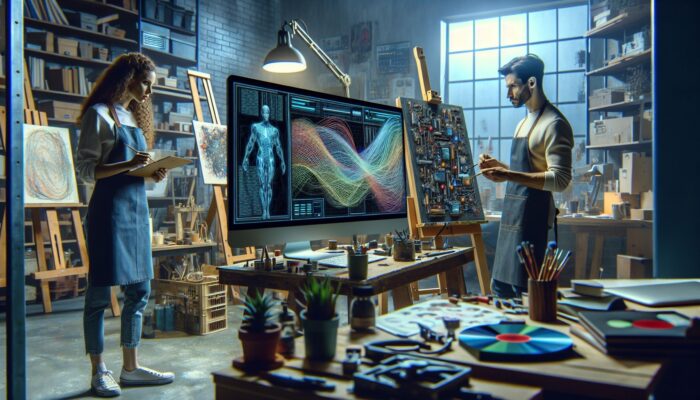
The Creative Transformation Isn’t a Canvas Away: AI in Creative Arts
Hey tech tribe! I’ve been thinking about this a lot lately, and honestly, I’m equal parts excited and mind-blown by what’s happening right now. We’re watching artificial intelligence completely reshape how art gets made, and it’s happening faster than I can keep up with the latest tools.
AI’s Brushstrokes on the Canvas of Creativity
You know how Bob Ross made painting look effortless? Those happy little clouds that somehow always turned out perfect? Well, imagine that same magic, but powered by computers that can process visual concepts faster than I go through coffee in the morning. Here’s the thing though – AI isn’t trying to replace the next Picasso. It’s more like having the world’s most patient art teacher who never gets tired of your weird ideas.
When DALL-E and Midjourney first showed up, I’ll admit I thought they were just fancy tech demos. Boy, was I wrong. These tools have become legitimate creative partners. They’re giving regular people like you and me the ability to explore visual ideas that would have taken years to develop by hand. The results? Sometimes they’re absolutely stunning. Sometimes they’re wonderfully bizarre. But they’re always pushing us to think differently about what’s possible.
Beyond Pretty Pictures: AI Transforms Entire Creative Industries
But wait, it gets better. AI isn’t stopping at visual art. Those friends of yours who make movie soundtracks or game music? They’re working with AI composers now, and the results are genuinely impressive. I’ve heard AI-generated pieces that gave me goosebumps.
These neural networks can analyze musical patterns with incredible precision. They’re creating compositions that feel both familiar and completely fresh. OpenAI’s MuseNet and Sony CSL’s Flow Machines are producing music that real humans want to listen to. Not just as novelties, but as actual songs worth putting on repeat.
The crazy part is that AI isn’t replacing human musicians. Instead, it’s becoming this incredibly sophisticated instrument that amplifies human creativity. Musicians are using it to break through creative blocks, explore new genres, and push their compositions in directions they never would have considered.
The Artist-AI Partnership: Creative Collaboration or Creative Competition?
This brings up the big question everyone’s asking: are we collaborating with AI or competing against it? From what I’ve seen, the most interesting work happens when humans and AI team up. Artists are learning to prompt and guide these systems, almost like directing a very talented but slightly unpredictable assistant.
The workflow is fascinating to watch. An artist starts with a concept, feeds it to the AI, gets back something unexpected, then builds on that surprise. It’s this back-and-forth dance between human intention and machine interpretation. The best pieces I’ve seen come from artists who embrace this unpredictability rather than fighting it.
But I won’t lie – there are legitimate concerns here. What happens to traditional art education? How do we value human-made art versus AI-assisted pieces? These aren’t easy questions, and I don’t think we have clear answers yet.
The Growing Pains Are Real
Let’s be honest about the challenges. Copyright issues are a mess right now. Many AI systems trained on existing artworks without explicit permission from the original creators. That’s created some serious legal and ethical gray areas that the industry is still figuring out.
There’s also the question of authenticity. When AI can mimic any artistic style in seconds, what makes art special? I’ve wrestled with this myself. My conclusion? The human story behind the art still matters. The intention, the emotion, the experience the artist brings – those elements can’t be replicated by algorithms.
And then there’s the practical stuff. These tools require significant computing power. Not everyone has access to the latest AI art generators. There’s a real risk that this technology could widen the gap between artists who can afford cutting-edge tools and those who can’t.
What’s Coming Next
Looking ahead, I think we’re going to see AI become as common in creative workflows as Photoshop is today. The tools will get more sophisticated, more accessible, and probably a lot cheaper. We’re already seeing AI that can generate video, 3D models, and interactive experiences.
The real excitement for me is in the possibilities we haven’t even imagined yet. What happens when AI can create personalized art that responds to your mood? Or collaborative pieces where multiple artists work with AI in real-time? The technology is moving so fast that speculation feels almost pointless.
One thing I’m certain of: the artists who embrace these tools early and learn to work with them creatively are going to have a significant advantage. This isn’t about replacing human creativity – it’s about amplifying it in ways we’re only beginning to understand.
Related: AI in the Creative Arts: Unleashing the Artist in the Machine